

Equations différentielles [Interactive]#
Sustainable Fishing Practices#
Author: Lars Quaedvlieg
1e |
2e |
3e |
4e |
|---|---|---|---|
x |
Fishing is an important economic activity and source of livelihood for millions of people around the world. However, overfishing and unsustainable fishing practices have led to the decline of fish populations and have put the long-term sustainability of fishing communities at risk. This is a complex problem that requires a multifaceted approach, including a combination of policy changes, improved fishing practices, and community engagement.
In this notebook, we will explore the issue of unsustainable fishing practices and the efforts being made to promote sustainable fishing.
You will examine the predator-prey relationship between fish populations and fishing communities and the impact of overfishing on the environment and human communities.
You will also think about the different strategies and approaches being used to promote sustainable fishing practices, including catch limits and size restrictions.
By the end of this notebook, we hope to have a better understanding of the challenges facing fishing communities and the steps that can be taken to promote sustainable fishing practices and ensure the long-term health of our oceans and the communities that rely on them.
The Impact of Overfishing on Ecosystems and Communities#
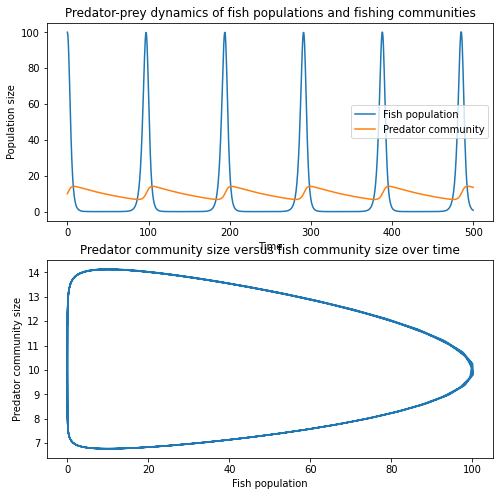
In the context of the predator-prey relationship between fish populations and fishing communities, we can use a classic predator-prey model, known as the Lotka-Volterra model. The Lotka-Volterra model describes the dynamics between two species, where one species is the predator and the other is the prey.
In this model, the fish populations represent the prey, while the fishing communities represent the predator. The dynamics of the system can be described by the following equations:
Where:
\(F\) = Fish population size
\(P\) = Predator (fishing) community size
\(r\) = Intrinsic growth rate of fish population
\(c\) = Capture rate of fish by the predator community
\(e\) = Conversion efficiency of fish into new members of predator community
\(h\) = Mortality rate of the predator community (meaning how quickly fishermen retire)
The first equation () describes the rate of change of the fish population over time, which is influenced by its intrinsic growth rate (\(r\)) and the rate at which fish are removed from the population due to fishing (\(c \cdot P \cdot F\)).
The second equation () describes the rate of change of the predator community over time, which is influenced by the rate at which fish are converted into new members of the predator community (\(e \cdot c \cdot P \cdot F\)) and the mortality rate of the predator community (\(h\)).
By using the Lotka-Volterra model, we can simulate the predator-prey dynamics between fish populations and fishing communities and examine the impact of overfishing on the environment and human communities.
The following is the code that does the simulation of the differential equations. It is not necessary to know how it works, but you can check it out if you are interested.
Show code cell source
import numpy as np
import matplotlib.pyplot as plt
from scipy.integrate import solve_ivp

# Define the Lotka-Volterra model equations
def fish_predator_model(t, y, r, c, e, h):
    F, P = y
    dFdt = r*F - c*P*F
    dPdt = e*c*P*F - h*P
    return [dFdt, dPdt]

def run_differential_model(r, c, e, h, F0, P0, t_max):
    t_span = (0, t_max)
    y0 = [F0, P0]

    # Solve the differential equations using the solve_ivp function
    sol = solve_ivp(fish_predator_model, t_span, y0, args=(r, c, e, h), dense_output=True)

    # Extract the solution values for fish and predator populations
    t = np.linspace(0, t_max, 1000)
    F, P = sol.sol(t)

    # Plot the results
    fig, ax = plt.subplots(2, 1, figsize=(8,8))
    ax[0].plot(t, F, label='Fish population')
    ax[0].plot(t, P, label='Predator community')
    ax[0].set_xlabel('Time')
    ax[0].set_ylabel('Population size')
    ax[0].set_title('Predator-prey dynamics of fish populations and fishing communities')
    ax[0].legend()

    ax[1].plot(F, P)
    ax[1].set_xlabel('Fish population')
    ax[1].set_ylabel('Predator community size')
    ax[1].set_title('Predator community size versus fish community size over time')
    plt.show()
Exercises#
Here are some questions that you could investigate by playing with the parameters:
You can play with the parameters by changing them (if you don’t know how, follow the tutorial at the interactivity section of the user guide).
# YOU CAN CHANGE THE PARAMETERS BELOW
# BEWARE THAT SOMETIMES THE SIMULATION MIGHT TAKE LONG TO RUN

# Set the model parameters
r = 1.0   # Fish intrinsic growth rate
c = 0.1   # Capture rate of fish by predator community
e = 0.01   # Conversion efficiency of fish into new members of predator community
h = 0.01   # Mortality rate of predator community

# Set the initial conditions
F0 = 100  # Initial fish population
P0 = 10   # Initial predator (fishing) community size

# Set the time span for the simulation
t_max = 500

run_differential_model(r, c, e, h, F0, P0, t_max)
Promoting Sustainable Fishing Strategies#
Now that you have experimented with different parameters, can you come up with some ideas to make fishing more sustainable?
Is it possible to modify the Lotka-Volterra equations to incorporate these ideas?
If you answered yes in the previous question, how would you do that (Advanced)?